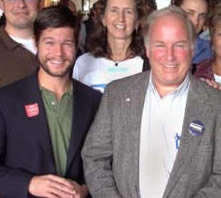
The Annual Brewgrass Festival is a favorite among Asheville residents and others who come from quite far away to attend. The festival’s draw derives from its primary purpose: To promote high-quality microbrewed beers from the Asheville area and around the nation. A little bluegrass in the background all day long rounds out the offering as a perfect compliment to the high spirits. Last year, the festival sold out in one hour. I have attended the last two myself and already purchased my ticket for this year (on sale 3/5/06 at their website).
Festival attendees pay once for a $25.00 general admission ticket and are given a small beer glass as they enter the grounds. They can then stroll the grounds at will all day sampling various microbrewed beers pulled from cold taps that are housed in row after row of vendor booths throughout the venue—and all of this without charge. Only the food and merchandise vendors take money.
Most will lay out blankets on the ground or set up folding chairs facing the band stage. Lines are generally no more than 5 to 10 deep and move quickly. The sunny outdoor festival atmosphere keeps everyone in a happy mood and there is a general sense of camaraderie that is sustained until the festival closes after dusk. The longest lines are actually found at the portable restrooms tucked away at far corners where some take longer than others.
Among the local sponsors of the event are popular downtown pub Barley's Taproom, Greenlife Grocery, and the left-wing radio station WPEK 880 AM.
This particular pursuit of happiness, however, was threatened by the city's mayor in an appalling demonstration of hubris and naked appeasement. Asheville's Mayor Terry Bellamy—who promised to be a mayor for all of the people and not just those who elected her—took active steps in a recent City Council meeting that would have made the sale and possession of beer at the 10th Annual Brewgrass Festival illegal.
First, the mayor removed an item from the City Council’s consent agenda that would have allowed the Brewfest, and 11 other popular festivals including Goombay, to sell and possess beer and/or wine. After passing the consent agenda without that item in it, Bellamy hastily called for a vote on the singled-out festival resolution without any discussion on the matter. Council voted on the resolution and it passed 6-1 with Bellamy against.
“Resolutions making provisions for the possession and consumption of malt beverages and/or unfortified wine at the following 2006 Special Events: 3rd Annual Earth Day Festival on April 15, 2006; Mountain Sports Festival on May 5-7, 2006; Downtown After 5 events on May 19, June 16, July 21, August 18, and September 15, 2006; 1st Annual Asheville Urban Jazz Festival on June 10, 2006; Fourth of July Celebration on July 4, 2006; 75th Annual City of Asheville Open Tennis Championships on July 20-21, 2006; 29th Bele Chere Festival on July 28-20, 2006; GoomBay! Festival on August 26-28, 2006; Fiesta Latina Festival on September 16, 2006; Asheville Greek Festival on September 22-24, 2006; 10th Annual Brewgrass Festival on September 30, 2006; and the Asheville Grizzlies home games at various dates throughout the summer.”
This was clearly a calculated move on the mayor's part. Knowing that her position was unsupportable and that the measure would pass easily without her assent, she decided to make a purely symbolic gesture out of her one vote.
The mayor is a known teetotaler, as are many in Asheville and this is a perfectly reasonable position to take for any private citizen; that is their choice. Bellamy's personal choice on this matter stems from her religious faith—again, a matter of personal choice that interferes with no one else's personal choices.
But for a sitting elected official to impose her own personal religious beliefs on the citizens and festival-goers of Asheville and beyond is a disgrace and a perversion of her oath. The mayor's moral views on alcohol consumption are simply not relevant. Nor are her moral views on the consumption of chocolate, pizza or gummi bears.
Unable to separate church and state, in either her mind or her official duties, the mayor, with this vote, put the imposition of her own personal religious beliefs on others above the will of the people and the economic interests of Asheville. Had the mayor's attitude been shared by a majority on council, Brewfest attendees would have had to settle for twelve hours sipping sweet tea.
Freedom breeds plurality. And in a free nation, the statecraft of politics has the responsibility of governing a pluralistic society; that is, a society with a multitude of subjective beliefs, principles and preferences that may sometimes be at odds with one another. One specific religious faith, however piously held, cannot be made the standard of morality in a pluralistic society.
Governments, however, much like physicians, must first do no harm. They must constrain their purview to essentials and look after only those elements of society that are held in common: the protection of individual rights from encroachments, predations and violations. When a city's mayor deigns to control the legal behavior of a free people, she has crossed the line between governing and controlling. This legislative act by an elected government official represents the kind of harm that comes to individual liberties when the objective domain of politics is overtly tainted with the subjective sensibilities of religion.
If a lawmaker chooses to deny themselves certain of life’s pleasures, that is their business. But when they want to also deny me those pleasures, then it becomes my business. The Mayor does not have the right to sacrifice my happiness on the altar of her religiously-based moral predilections.
I’m happy that the Founding Fathers formulated a social system that is designed to protect my rights. I would be very pleased if modern politicians would limit their range of action to the system that the founders designed.
In my opinion, not only should a person have the right to pursue their own happiness, I believe they should be able to do so in the manner of their choosing without the strained permission of puritans.
"That government is best which governs least." -Thomas Paine
Should the government own and operate a commercial business?
Should the government run schools, water systems or outdoor music festivals?
Does the government have special knowledge that makes it the best vehicle for delivering products and services to the citizens who have loaned it their power?
Or should government limit itself to what it does well and leave the rest to the marketplace of talent, expertise and efficiency.
There are two small towns in America that are attempting to answer these questions; not theoretically, but with real public policy enactment. These two towns have very different views on the role of government in small-town America: One is Sandy Springs, Georgia, and the other is Arcata, California.
Sandy Springs has adopted a more libertarian, hands-off approach while Arcata has its micromanaging fingerprints on virtually every issue in the public arena, to even include officially passing judgment on national and international matters.
The coastal college town of Arcata, California, situated in upstate Humboldt County near the famous marijuana fields of The Emerald Triangle, has finally rounded out its 5-member city council with an all-progressive team, to include the mayor. In fact, three current council members belong to the Green Party. Even the local sheriff calls his hometown “the People’s Republic of Arcata.”
"Government without true democracy threatens the well-being of planet earth." -Arcata Vice Mayor David Meserve
Ken Hoover, a reporter from the Arcata Eye newspaper, labors to point out that the Green Party in Arcata is “dysfunctional.” But the fact remains that Arcata's leaders "lean about as far left as you can get in America.” This remark was uttered by Fox News anchor Brit Hume who reported on this quiet community in a two-minute piece January 17, 2006, and brought to a wider public view developments previously hidden behind the veil of isolation.
But I don't know who to believe; number one rated Fox News or a local Arcata broadsheet that characterizes a prominent female Fox News correspondent as one of “the shimmering Botox-blonde newsbunnies the network appears able to manufacture at will.”
At any rate, perhaps we can judge the nature of their city government more by their actions than any other measure.
The anti-Bush council adopted a “New Year’s Resolution” demanding the impeachment or resignation of the President and Vice-President for the crimes of misleading America into war, the crime of responding slowly to Hurricane Katrina, the crime of spying, and the crime of torture.
Arcata has produced a Greenhouse Gas Reduction Plan and a Pesticide Reduction Plan. Among its several boards and commissions are the Nuclear Free Zone Commission, the Open Space Committee, a Homeless Services Plan Task Force, and the Committee on Democracy and Corporations. City Council has already placed a ban on national chain retail stores.
Greens, liberals and Leftists are having a field day in the wetlands of Arcata. But that is their right, is it not? They were voted in by a majority and they can do as they please.
In severe contrast to the strident developments taking shape in Arcata, let’s turn now to the emerging changes we see in another similar small town; this time closer to home, in Georgia.
In December of 2005, the newly incorporated City of Sandy Springs, Georgia, just to the north of Atlanta proper, rose not from ashes but from a 30-year struggle to fend off the greedy advances of an engulfing, Democrat-controlled megalopolis. Actually, this new city of 84,000 has been in the making for about 80 years as a nascent and thriving family-oriented community. Mayor Eva Galambos, quoting a favorite weblog, says, “Giving birth to the city of Sandy Springs is like birthing a teenager.”
Rather than continue subsidizing surrounding Fulton County, Atlanta and 10 other existing cities to the tune of $190 million a year, Sandy Springs, with the approval of 94% of its electorate, made the bold move to set its own course, take back the better part of its money, and deliver high-quality, low-cost public services in a more federalist-oriented, common-sense way staffed with only a mayor, a city council, and a handful of city employees.
Now, finally, the raspy-throated advocates of virtual annexation go quiet as Sandy Springs embarks on a political experiment perfectly un-thought-of by it menacing municipal neighbor: To privatize nearly every city function and constrain its own circle of action to the essentials of setting policy, community planning and budgeting. Basic city services will be managed but outsourced wherever feasible. Mayor Eva Galambos claims,
“We have harnessed the energy of the private sector to organize the major functions of city government instead of assembling our own bureaucracy. This we have done because we are convinced that the competitive model is what has made America so successful. And we are here to demonstrate that this same competitive model will lead to an efficient and effective local government.” – Inaugural Address, November 30, 2005
Other localities, namely Milton and Riverside, stand ready to emulate Sandy Springs and incorporate with the same perspective on government responsibility, accountability and transparency as its predecessor. Even existing municipalities in the area, like Roswell and Alpharetta, are watching closely to see if this particular brand of government might not be right for them as well. Indeed, the example of Sandy Springs may bring a boom in city-building throughout unincorporated Fulton County—and beyond.
“The eyes of metro Atlanta, of Georgia, and indeed, the nation, are on us as we begin our wonderful civic adventure in self-government.” – Mayor Galambos, Inaugural Address, November 30, 2005
The cities of Sandy Springs and Arcata are polar opposites in many ways. But they have some similarities: Both are eager to regulate the types of businesses they will allow.
Sandy Springs has developed a strict set of codes regulating adult entertainment operations such as strip clubs and pornography shops. WSB-TV reports that “The Sandy Springs City Council approved measures...that prohibit alcohol and VIP rooms at adult clubs in the city. In addition, video stores in the area cannot have 'booths' anymore and the shops must also be 400 feet from churches. They can stay for 5 years at their current locations, but then they have to move to a district that will be selected and zoned for such activity.”
The first order of business for Arcata’s oddly-named Committee on Democracy and Corporations was to propose Measure F, the ‘formula restaurant’ cap, effectively banning chain stores. With Measure F, which passed by 60% as a referendum, Arcata has “banned certain types of formula businesses. These laws do not prevent a chain store from coming in, but they do require that the incoming chain not look or operate like any other branch in the country. This has proved a significant deterrent to chains, which generally refuse to veer from their standardized, cookie-cutter approach.” The Arcata ordinance, No. 1333, limits the number of formula restaurants to a grand total of nine. From Hometown Advantage:
“Formula businesses include retail stores, restaurants, hotels and other establishments that are required by contract to adopt standardized services, methods of operation, decor, uniforms, architecture or other features virtually identical to businesses located in other communities.”
So Sandy Springs bans hard-core porn and Arcata bans Shoney’s. Thus, even in their similarities they are dissimilar.
So what does Asheville have in common with either Arcata or Sandy Springs?
Certainly, our locals have a corresponding penchant for bumper-sticker activism. But more seriously though, they have now voted in the most progressive city council in its history. The city that used to be innocuously referred to as the “freak capital of the South” has now come to be dominated by hard-line, Left-leaning, anti-capitalist, big government, busybody political bullies bent on stamping out jobs, compelling you to junk your car and ride the bus, and planning Asheville into a ghost town of starving artists and hungrier taxpayers.
And what is their view of the role of government in a free society? Again, the similarities with Arcata are predominant where government is increasingly the answer to social and economic questions.
Asheville has as one of its key assets a creaky civic center in disrepair, which perennially operates in the red and has repair estimates in the millions. It is interesting, though, that one council member recently remarked that “it’s pretty hard to make the case that we should even own a civic center.”
When sound, high-density residential development comes to town, we blithely require that they simply tack on prohibitively expensive “green roofs” to their limited budget in exchange for permission to provide attractive, affordable and much-needed intown housing.
We deny cab drivers the right to set their own prices in a free market for the services they provide by haggling in city hall over a three-cent per 1/10th mile rate increase. However, Asheville is certainly not unique in this detrimental interference in the marketplace.
We throw up so many barriers to the world’s most successful retail chain that it faces costly delays and perhaps even has to return to the drawing board to reconsider the wisdom of providing Asheville with hundreds of jobs and millions of dollars in tax revenues.
We pass out biased, anonymous surveys to merchants in order to determine, albeit through consensus, specifically in what manner we will control other people’s property with ordinance modifications. Call it consensus or democracy—mob rule in politics is an affront to individual liberty.
We are happy to repeat California’s mistake of legislating open space leading to the economic banishment of low-wage workers, renters and home-owners.
Our police and fire-and-safety departments are terribly understaffed and underpaid and yet council members are quick to point out that the city’s personnel budget is already bloated and there appears to be no more room for increased payroll expenditures at this juncture.
And we now see a progressive majority, engaging in a purely political abuse of power, daring to completely shut out the minority and aggressively pack boards and commissions with like-minded comrades who will push the preeminent Leftist agenda on every issue open to governance.
Who, in the end, is left to pay for these errors? The working poor who are being squeezed out; property owners who now might like to sell out; business owners who pass along their tax and regulation burdens as higher prices and lower wages. Even the Leftist’s who voted in this kind of government will pay as taxes and costs increase while services and opportunities shrink. It would appear that the Left voted for its own welfare before it voted against it.
In the end, we seem to have more in common with the tired, suffocating approach to governance found in the Left-coast city of Arcata than the freedom-loving, Constitutional approach displayed by the newly-minted Southern city of Sandy Springs.
In the philosophical tug-of-war between the overbearing governmental excesses of Arcata and the refreshing, liberty-oriented model provided by Sandy Springs, we, the citizens of the city of Asheville are witness to a moral contest played out in the real world that must certainly result in entirely different outcomes.
And as we watch for those outcomes to materialize with equally real-world consequences for the long term, we still have our own moral struggles to encounter. Here in Asheville, we bob and billow in the swells of a momentous sea-change that will define our particular stand on the role of government for years to come.
Solemn history, however, will note whether or not this change will indeed represent that progress that our elected leaders have so fatuously touted.
RELATED
Sandy Springs, Georgia: The City that Outsourced Everything
A Georgia Town Takes the People’s Business Private
By David Segal | New York Times | June 23, 2012 Does the Sandy Springs approach work? It does for Sandy Springs, says the city manager, John F. McDonough, who points not only to the town’s healthy balance sheet but also to high marks from residents on surveys about quality of life and quality of government services.
The City Council of Asheville, City Staff, and the Planning and Zoning Commission have responded to the pressures of certain neighborhood alliances and concerned citizens and intend to overhaul development ordinances for the Merrimon Avenue business corridor to be more closely aligned with their wishes for its future. Merrimon Avenue is a burgeoning, 4-mile commercial strip running through North Asheville connecting it to the communities of Beaver Dam, Woodfin and Weaverville.
One method they will employ as an input into these code revisions will be the results of an 8-question survey to ascertain the general mood of business owners and residents. Ostensibly, the objective of the re-zoning of this major corridor and gateway to the city is to encourage development that is viewed as popular or desirable and limit or constrain what is unpopular or undesirable.
What is at stake is the ability of property owners to determine the best use of their resources in this thriving sector of the city. Also, considerations of street widening, signal calibration, bike lanes and sidewalks will be taken into account.
Merrimon Avenue is not owned by the city but is maintained by the state. Several years ago, in an effort to alleviate congestion, NC DOT completed a feasibility study on Merrimon Avenue to consider widening the road from its current three-lane configuration to five lanes. The costs involved in the necessary purchasing of rights-of-way by the City make the project financially unrealistic. Another proposal to break up traffic bottlenecks, suggested by some concerned citizens, recommends turning Merrimon Avenue into a two-lane highway with a middle turning lane. However, it is highly unlikely that DOT would approve such a change.
Ultimately, by a 6-1 vote, City Council approved mailing the survey to business owners and residents along the Merrimon Avenue corridor on February 1, 2006, with the expectation that responses could be compiled, documented and analyzed by February 28th in preparation for a draft re-zoning proposal to be assessed, revised and finalized by the end of April or soon after.
In contrast to Carl Mumpower’s lone dissent on the entire question, Mayor Terry Bellamy urged that others outside the immediate neighborhood also be encouraged to respond to the survey. The Mayor stated at the meeting that this is a very important issue and that everyone using Merrimon Avenue has an interest in how this vital corridor is to be developed. Targeted participants can further disseminate the survey to friends and associates. The survey is available online and is even being advertised in rotation on the City's cable TV station on channel 11. All of this, purportedly, in an effort to gain an adequately wide set of data for input into the rapidly approaching re-zoning deliberations.
The effort to involve a community of interests in determining the future of Merrimon Avenue is laudable. But the method of information gathering exposes the process to certain risks that can have significant if not fatal consequences for the economic health of the commercial district in question. In fact, a large number of Merrimon property owners have recently formed an association of their own to help protect their interests in this process. They have expressed concern that their interests might be minimized or possibly overlooked entirely by zealous activists during the hasty fact-finding process.
A quick read of the questionnaire that promises to inform zoning decisions provokes a number of questions. First among them: Is this survey free from bias? Second: Is there any risk of fraud, error or misinterpretation? If so, to what degree?
One problem that is immediately evident in addressing these questions is the fact that the survey is anonymous. Ideally, the person who was mailed the survey will be the one who submits the survey. But there is no guarantee of this. One person could submit multiple surveys with the same responses and effectively skew the results. In fact, with the anonymous survey available online to anyone with an internet connection, there are no controls at all to ensure that the responding survey population is the same as the targeted survey population. If this survey is to be anonymous, as it is, then ultimately the results can be subject to selection bias and called into question and dismissed as distorted until a ‘bona fide’ survey can be conducted that could trace responses to legitimate individuals within the original targeted population.
Another problem is that the questions in the survey are leading. They tend to lead the respondents to socially acceptable answers prompted by groupthink. This exposes the survey to the risk of social bias. This is the pressure respondents might feel to conform to socially-accepted points of view. Responses could be reflective of a social construction of reality where we compare our views with a favored in-group to gain reassurance that our views are not at variance with consensus; also known as the bandwagon effect.
Then there is the problem of misinterpretation. The brief survey asks only 8 narrowly-defined questions and the multiple choices offered are not exhaustive. This can lead to confirmation bias, which is a tendency to search for or interpret information in a way that confirms the surveyor’s preconceptions. That several of the questions are open-ended only increases the risk of misinterpretation. There is also the problem of non-responses that can weight the results in favor of activists. And surveyors may interpret vague or blank responses in ways that might support a preferred result.
The survey is open to information bias. Respondents are likely not economists and may not have the objective means for determining what is in their own economic interest. In fact, they may harbor distinctly anti-business prejudices that could color their responses in subjective ways and leave the impression that the interests of business-people and those of the community are at odds and may be irreconcilable.
Finally, there is the issue of the timing of the survey. We have heard from representatives of the neighborhood associations that “time is of the essence” in developing a satisfactory set of codes. To be sure, Merrimon Avenue is rapidly growing and needs to have the proper rules in place to guide development. But is this really the right moment to take the temperature of the public on the far-reaching question of zoning in this vital sector of town? And must the process turn around in the span of 2 months? This survey rolls out at a time when emotions are running high over recent development mishaps, intentional or not. To name just a few sore points:
The newly constructed Staples office supply store, which has complied with the letter of the law in the Uniform Development Ordinance (UDO) and the Asheville 2025 Plan, is alternately described as a behemoth or an eye-sore by anti-development advocates and some in the media because of its menacing, fortress-like red brick street abutment and gaudy signage.
The uncomfortable proximity of the awkward Greenlife grocery loading dock has exited great anxiety among certain of its neighbors and outright furor in others. The conflict has generated angry protestations at the site, in the media, and in City Hall.
Recently, Walgreen’s drugstore flagrantly ignored binding construction agreements prompting the City to quickly issue a “stop work” order and initiate an investigation into the violations. The developer had applied for a permit to “renovate” the old Ace hardware store on that site; however, without proper approval of a variance, they moved ahead to demolish the building completely and begin construction of an entirely new building with a 112% improvement value estimated at a cost of $1 million. This far exceeds the definition of “renovation” which is limited by code to a 50% improvement cost.
The bottom line here is that this may not be the best time to gain a cool-headed assessment of the long-term zoning constraints that would be placed on future development initiatives. Could we possibly get a different set of survey results, say, a year from now? At the meeting to approve the survey, Carl Mumpower stated that, with the exception of a few new buildings and the refurbishing of some others, the corridor had not changed appreciably in the past 10 years.
Opinion
Council member Robin Cape has raised the possibility that the Merrimon Avenue Zoning Study could become a model for community development at large in Asheville‘s future I have to hope not. There is too much at stake here and there are too many risks involved in this particular methodology for it to become a standard response to economic development.
With the exception of the self-inflicted Staples debacle, the present zoning of the corridor has served the community very well. Property owners wishing to build or expand outside the constraints of present ordinances must seek approval from the P&Z Commission and then City Council. During this case-by-case review process, neighbors have an opportunity to express their concerns. To now overlay such a large area with a one-size-fits-all straight-jacket is an example of inappropriate and overzealous planning that may not retain its appropriateness over the long-term.
The demand-driven marketplace will determine the future of Merrimon Avenue and the risk of fraud, error, misinterpretation or possibly outright manipulation in this information gathering process lacks the gravitas sufficient to the proposed task of setting guidelines for business owners, property owners and entrepreneurs who are clamoring to invest in our city and stimulate our much needed economic growth.
We should all be encouraged to provide input into what Asheville is to become. And we do so with home sales, rents, and purchasing dollars. We vote with our feet, our cars and our wallets. To hand over our economic future to an elite cadre of activists, interlopers and phantom citizens does us all a disservice. Will activist students in temporary residences at nearby colleges become involved in the Merrimon Avenue study, skew it’s results, and dictate the city‘s future growth for the rest of us? At a large demonstration recently held to oppose a new Wal-Mart Super Center proposed for Smokey Park Highway in West Asheville, over 90% of the 100 demonstrators were students from UNC Asheville and Warren Wilson College in Swannanoa.
As many know, long-time Asheville resident and political activist Leslee Kulba has become the heart and soul of pro-individualist politics in Asheville. You can find her anywhere the voice of liberty needs to have a say. And in Asheville, that is a lot of places.
She regularly attends City Council meetings and reports on the proceedings to a select mailing list. The report she produces emerges from copious notes furiously scribbled on notepad sheets as she strains to hear every comment uttered at hours-long meetings and worksessions. Those lucky enough to receive her finished product by email find it indispensable and the key to staying informed about public policy in the City.
Leslee is no mere stenographer or news reporter. First, Leslee does her homework long before attending these public meetings. She carefully reviews the Council agenda and picks through staff reports and supporting documents. While reading through dry text, tables, charts and drawings, Leslee sees beyond the surface print to discern the underlying context. Aspects that other observers can overlook emerge in high relief in her mind. And she is quick to pounce on suspicious incongruities or reckless fast-track proposals that might risk compromising Constitutional principles, the corruption of ethics, or the circumvention of due process and precedent.
Immediately on the heels of adjournment, Leslee dashes home to transcribe her chicken-scratches into a coherent chronological record; often working well into the late night. The final version of her City Council Report contains more than a factual re-reading of a stuffy meeting. It is throughout peppered with incisive commentary, hard-nosed libertarian perspective, coveted insider knowledge, and biting wit and sarcasm. All the while, the report maintains an informal, conversational feel that makes for a friendly, comfortable read.
I am proud to be able to take Leslee's report, with her permission, and format her text for the web on the Asheville City Council weblog. I will also, on occasion, add some of my own commentary--again, with her permission--that I think will enhance the overall quality of Leslee's product. With the addition of a few photos from the event, this version of Leslee's report provides the best presentation of what she has to offer: an informative, compelling and accessible re-telling of a story about public policy-making in progress wrapped in a slick and pleasing package online. This, I believe, is the treatment Leslee's brilliant and tireless reporting deserves.
Besides composing her own privately-distributed Council reports, Leslee is often called on to write columns for several local newspapers. She is a regular contributor to the Mountain Guardian which happily prints her every un-edited word no matter the length. She is also published in the conservative Asheville Tribune. And her letters-to-the-editor are often found elevating the common discourse in papers such as the Asheville Citizen-Times and the Mountain Xpress.
Beyond the printed pages of these publications, Leslee's abundant and insighful opinions spill over into the hit-and-run emails she sends to the many email lists she belongs to, enriching the conversations there and giving passive readers evidence that ideals, passion and an indomitable urge to action are not withering on the her vine.
Leslee can also be found sitting at table with our local Libertarian Party members for their social gatherings. In fact, Leslee is the Secretary and publishes the meeting minutes as organizational matters come up in conversation. She has been a member of the Libertarian Party locally for many years, until forced into the Unaffiliated Party by North Carolina law.
Leslee can be found regularly attending any number of local gatherings, such as the Buncombe GOP or the Coalition of Asheville Neighborhood meetings, to keep up with the several hot-topic community issues bubbling to the surface as Asheville feels its growing pains.
During election season, Leslee wears herself out vigorously campaigning for her favored pols. If a candidate is Constitutionally-principled, consistently pro-liberty, and of high moral character, Leslee will throw them her support with the greatest of energy and commitment. Whether the campaign needs signs painted, leaflets distributed or neighborhoods canvassed, Leslee is ready to devote boundless energy to the cause and sweeps many others into her tailwind as she moves forward to realize her objective of turning this city in the hills into a "City on a Hill."
Finally, I have to confess that I am proud to know Leslee Kulba and to be able to work with her on any project she deems worthy of her attention and effort. Anything I do in the political arena in Asheville is from the perspective of standing on her shoulders. Any time I add to her output or activity, it is done only to enhance the value of what she already brings to the table. Not only to I like Leslee personally, I deeply admire Leslee's talent and professionalism, her uncompromising devotion to her principles, her unflagging commitment to focus herself and her fellows on the essentials, and her drive to achieve what is best for our city and our country and place us all on the side of the angels.
In a recent letter to the editor to the Asheville Citizen-Times("Help make a Department of Peace a reality," 1/3/06), Asheville resident Catherine Holt recommends creating a new department in government: A Department of Peace?
Now isn't that just precious?
She says, "...governments pursue their aims through violence and warfare, and military force is seen as a legitimate way to resolve disputes ...”
I would remind Ms. Holt that the wanton, wholesale murder of 3,000 innocents is not a "dispute." It is an act of war. The only thing in dispute is whether or not I have a right to live. And I have a very unresolvable opinion about that.
I would like to thank the Department of DEFENSE for protecting and preserving the kind of country that gives these precious lunatics the freedom to champion any fantastical, hare-brained scheme that might emerge in their vacant minds, and the latitude to roam freely in the streets unsupervised and unmolested.
I thank the peace-makers in the military. And President Bush: I support you in your difficult task; and any successor who promises to maintain your resolve to protect America from inhuman terrorism, to protect American interests worldwide, and to propagate liberty wherever it is wanting.
I found two editorials published today in the Asheville Citizen-Times to be deeply offensive. One by Bruce Steinbicker and another by Jean Franklin.
According to these two guest editorials, the vigorous defense of a Christian Christmas can be described either as "pitching a hissy fit" or a "sideshow" or a "tempest in an eggnog cup."
I'd like to see these writers apply their arguments to all those people who claim to be offended by Christian religious symbols during this season. Are they pitching a hissy fit? And can we apply this same argument to those who are offended by racial epithets. Are they engaging in a sideshow or stirring up a tempest in a teapot? The simple fact is that some things are worth defending. And the preservation of the distinctly Christian character of this seasonal holiday is one of them.
Also, in her editorial, Jean Franklin arrogantly digresses into a lecture on the etymology of the words Christmas and holiday which I found condescending and irrelevant. This is commonly known as a "red-herring" argument. It’s a way of introducing a divergent topic in order to change the subject. And change the subject she did by then quoting a Leftist, anti-Walmart propaganda film as her source of information for the purpose of reiterating tired anti-capitalist clichés.
Bruce Steinbicker, in his editorial, refers three times to "right-wingers" and disingenuously asks that they explain themselves in all of this. I had not considered that the defense of Christmas was the exclusive charge of the Right. Now I know.
Steinbicker concludes his snarling editorial by suggesting that we Christians should emulate an even better holiday than Christmas: Kwanzaa. That’s the phony holiday cooked up by a Black militant in Los Angeles in the 60’s specifically designed to compete with Christmas and divide people along racial lines.
The central subject, which Mr. Steinbicker and Ms. Franklin work so hard to obscure, is the intentional and aggressive de-Christification of a specifically Christian holiday by a cultural elite that is emboldened by the passivity of the complacent faithful. Now that that passivity has been shaken off and a campaign to preserve a valued cultural heritage has been successfully mounted, they want to cry foul and lash out with sanctimonious sarcasm and juvenile, hate-filled rhetoric to denigrate all those who would dare to speak up in the face of their transparent assaults.
It sounds like somebody's having a hissy fit and needs a "time out."
In a recent letter to the Mountain Xpress ("Why quote Mumpower, when he stands alone?" 12/21/05), Mountain Area Information Network, (MAIN) Director Wally Bowen complained that TV station WLOS quoted Asheville City Council member Carl Mumpower, and no one else, even though the motion to waive market-driven pricing on antennae placements and offer MAIN a discount was approved 6-1, Mumpower dissenting.
Mr. Bowen, claiming that the report was incomplete, although not in error, first charges that Mumpower brought to Council's attention that MAIN is a decidedly political organization; a factual claim that Bowen reinforces himself saying, "nonprofits are not prohibited from engaging in political speech." The problem here is that no one has disputed MAIN's right to promote a distinctively partisan political point of view--which indeed it does. On any given day, you can find some mention on MAIN’s website of the standard Leftist complaints and tired arguments. Mr. Bowen then admits that "Mumpower is entitled to his view." So much for argument one.
The reason Dr. Mumpower was quoted by WLOS was because he pulled the item off the Consent Agenda and was the only Council-member to comment substantially on the matter. “Why quote Mumpower when he stands alone”—asks Bowen? Mumpower should have been quoted precisely because he stood alone. That was the story: Mumpower’s dissent!
Second, Bowen takes pains to explain that his monthly rent would be, not $200, but $200 thrice, since MAIN intends to employ three antennae at the discounted rate. Here again, Bowen is not presenting any new compelling information. As he states himself, rent would be set at $200 per unit, as factually reported by WLOS. This is well under the $600/month normally required to compensate the City for their cost of doing business. And who picks up the tab for the difference between cost versus discounted rent payments? The already tapped-out City residents who generate tax revenues..
That city taxpayers will subsidize three antennae instead of one is a bookkeeping detail that does not significantly alter the facts as reported by WLOS. MAIN will be paying a reduced $200 per unit no matter how many they choose to rent, one or one hundred. So much for argument two.
What Bowen fails to appreciate in his misapplied rejoinder is the essence of Mumpower's dissent: MAIN, being primarily a partisan political media organ, in this case on the Left, should not be afforded the consideration that Council majority has given due primarily to its explicit intellectual bias and its rather transparent motives.
Bowen’s intent, it seems clear, is to extend his influence beyond Asheville and across the mountains by supplying a seemingly innocuous service to needy subscribers that will then draw them to his websites, newsletters, and radio programs with the aim of immersing a captive audience in his political bias. This will be the first step in putting the imprint of Leftist Asheville onto a greater Buncombe County and sets in motion the fulfillment of Bowen’s vision—one presumably shared by City Council—which is to insidiously convert county residents to his political persuasion and then deliver them to a national Leftist movement—ideally, in time for critical elections.
Our new progressive City Council has allowed a nonprofit organization that shares their own partisan political leanings to offset their expenses using the property of the hard-working tax producers of Asheville. Then certain Council-members turn around and reap the benefits of their own largess by subscribing to services provided by MAIN whose operating expenses have now been reduced by direct Council action. Mayor Bellamy and Council-members Jones, Davis, Freeborn and Newman all have accounts with MAIN; and Robin Cape used to host a program on MAIN’s radio station WPVM: The Progressive Voice of the Mountains. In the vote to allow subsidies for MAIN, these Council members should have recused themselves. That would have left Mumpower alone to decide the matter. (Would it were so.)
So it would seem we have expanded our working definition of what it means to be a progressive on City Council: To cavalierly hand out sweetheart deals to their pals at our expense as they laugh all the way to the Westville Pub. (Oh, for joy.)
Despite Wally Bowen's insistence that we thoughtlessly treat his own private Wally-World as just another generic, run-of-the-mill nonprofit—in the end, we cannot. And, indeed, must not.
And City Council should not be in the business of handing out favors to its favorites, Left or Right.
UPDATE Bowen's letter to the Mountain Xpress has been reprinted in the Wed Dec 28th edition of the Asheville Daily Planet (pg. 14).
Bowen's letter to the Mountain Xpress has also been reprinted in the Wed Dec 29th edition of the Asheville Citizen-Times.
Last night, the development team for the proposed west end Wal-Mart Super Center held a public forum at the West Asheville Community Center to share their plans for the project and field questions and concerns and take any other input on their large development initiative that the community might want to provide.
One Leftists in the crowd rudely interrupted the opening presentation by insisting that he be able to begin the question-and-answer period on his own timetable rather than allowing the speakers to finish the overview.
The question period having now begun, other angry voices piped in to express their own personal resentment regarding general issues related to Wal-Mart and its operations. This was not the intent of the forum and I took the opportunity myself to shout down these interruptions and point out that this was not an activist session.
Shortly afterwards the most vocal Leftists walked out and the civil portion of the meeting got underway. There were still some passionate questioners and some hostility sprinkled throughout the rest of the meeting, but by-and-large genuine concerns were being raised about noise, light, traffic and housing displacement. These concerns were all addressed by the development team, which included a Wal-Mart attorney for the project.
It appeared that many in the audience did not understand the process of zoning, regulation and city government in general and I can certainly sympathize with that. Catching that tiger can require a certain stamina. But it seemed that the disgruntled minority simply thought that they could disregard the systematic process that brought us to this point and show up at one meeting, express a few tight little anti-capitalist bromides, sign a petition or two and then this would all go away.
And while all this confusion and cross-talk proceeded, we actually had a member of City Council sitting quietly in the audience with us through the entire meeting: Bryan Freeborn. Mr. Freeborn had nothing to say on any subject but instead listened attentively while citizens discussed buffers, tree-planting, zoning, business development, net job loss, the morality of the marketplace, and a host of other issues; many of which the developers were not there to discuss but which would be more proper to bring to planning boards and City Council.
Finally, one last lonely Leftist (sitting next to Freeborn, by the way) spoke up saying, "I don't think we need another Wal-Mart. I won't be shopping there and no one I know will be shopping there."
In response, I raised my hand and said, "I love Wal-Mart and I love shopping there every day." This elicited a smattering of laughter and some goony looks from the crowd. Then the developers decided to wrap the meeting on that positive note and we adjourned for the evening.
Afterwards, Leslee Kulba and I compared notes and agreed that Asheville has a long way to go in understanding basic economics, the law of supply and demand, and that, contrary to one questioners complaint that the voice of the people was not being heard, the real voice of the people could be found in the poster-sized architectural renderings and photos of the new proposed Wal-Mart destined to rise up on the west end and satisfy a felt need that they would only be happy to fill.
General congratulations are in order for the winners of our recent city elections, hard fought and handily won by the so-called progressive political element in Asheville. The remaining question before an empowering public now is who should properly fill the two-year City Council vacancy left open by the transference of Ms. Terry Bellamy from Council-member to Mayor.
Even though failed candidate Bryan Freeborn received the fifth-highest number of votes overall, with 7,319 just behind Dr. Joe Dunn's 8,004 votes, sheer popularity among partisans cannot be made the sole criterion for selecting a candidate to represent a diverse body-politic until the next election offers that citizenry an opportunity for course-correction.
I contend that the extreme left-wing activist Bryan Freeborn is unfit for service on the Asheville City Council due mainly to his well-documented character flaws, his juvenile flouting of municipal authority, and his demonstrated disdain for the sober process of the law.
In view of Dr. Dunn's new-found revulsion for local politics, I suggest we look for another grown-up for this important post. And, in my view, that grown-up is Chris Pelly.
"The issue today is the same as it has been throughout all history, whether man shall be allowed to govern himself or be ruled by a small elite." -- Thomas Jefferson
IN THIS GENTLE AUTUMN SEASON, as the trees shed their colors, we find ourselves once again looking deep into the landscape to spy what nature’s unveiling reveals.
Every shack and chalet, once hidden, peeks through a naked row of trees to announce themselves to our consciousness. We are again reminded that things long-concealed by cover can quickly lose their seeming distance and rejoin a visible scenery.
And winter's closing in.
Now, in our fair town, the revelations of nature find their counterpart in the stark arena of human action. An election season has come—and passed—and it has brought with it a similar shedding of cover that lays bare something long-suspected but only just out of sight: A creeping statist vision of command-and-control that seeks to aggressively plan the minutiae of your life, to further constrain individual liberties, and to control dissent through media puppet-masters and the raw exercise of governmental power.
In many ways, Asheville has readied herself for this moment. Committee after committee has churned out page after page of reports and recommendations that address every aspect of the life we used to freely choose. Now those choices will be made for us. And our talents and creativity will be brought to heel to serve the vision of a rising New Class and the Prophets of Order who cheerfully propose to engineer a better life for your own good. Their methods, among others, will include interference in the marketplace, oppression through taking, coercion through regulation, and relentless demands for conformance. Coupled with this approach is a cool indifference to property rights and an overt hostility toward the regional values and traditions that have carefully built up a foundation of permanence and hope.
Let’s look at some of the several ways the elites plan to reconstruct and micromanage your lives:
I challenge you to read and fully comprehend the consequences of any of these monstrosities. The HUB Project alone will leave your head spinning with its sweep and ambition.
“The 2025 Plan is one of things I first want to look at.” –Terry Bellamy
“The city already has a good plan [the 2025 Plan], but the current majority of council chooses to ignore it.” –Robin Cape
“Ride more bikes.” –Bryan Freeborn
Yes, rather than tend to the proper role of city government—which is to provide basic services and protect individual rights—the giggly inmates are running the asylum and they have their eyes on your change-purse.
The chief activity conducted by the Asheville City Council consists of civil piracy. I'll be damned if they think they can take my private property and money so they can build a network of bike paths for Bryan Freeborn and the Speedo concession. Yes, we want your money--"AND YOUR LITTLE DOG TOO!"
And they have the gall to call themselves progressive. Progressive?! Hey, look: Cancer is progressive. Seriously though, "progressive" is a just a euphemism for “Leftist.” What the progressives are advocating is a hundred years old--and it didn't work then. The Leftists are about as progressive as the Piltdown Man.
When they do ask for input on how best to spend their greedy accumulation of tax dollars, my response is simple: “Give it back and then stop confiscating it. It's not the role of government to take property from those who have earned it and give it to those who have not. If you want to help people afford housing, stop forcing people to live in high-density like lab rats, stop raising taxes, stop scaring away businesses, development and jobs and give up your overblown pipe-dreams of yellow-brick bike paths and rickshaws to Utopia.”
The day when these elitist visions were held in abeyance is over. The voices of reason have been sent packing; or allowed to stay and bark in a darkened corner. Joe Dunn has been voted off City Council and Carl Mumpower is in the extreme minority of one. There is little left now to stand between the tax-producers and the tax-consumers.
The voters have spoken and you would think that they want you to live in a crunchy-green Disneyland scrubbed clean of the flesh-and-blood serendipity of human action; the open process of free minds operating in free markets that dares to craft its own path to happiness without the arrogance of effete intellectuals trumping the common sense of free men and women at every turn.
You can relax your fervor and passion for life lived on your own terms. Remember folks, the expensive reports listed above are not simply lovely suggestions on how the free market ought to operate. These are P-L-A-N-S for Y-O-U. They are enforceable only by the iron police power of government. You must conform to the directives of your betters or suffer the consequences. You can have it “any way you like it” as long as you like it the way we make it.
If you had any thoughts on how you want to live your lives free from government interference or how you’d like to preserve the lifestyle you have come to cherish, forget it. It’s all been done; it has already been thought of. You are no longer needed. When the newly-formed City Council convenes this month, you will be officially in the way. If you can’t get with the program, City Council will certainly be about the business of thinning the herd. They can do what they like. After all, they have received a mandate.
What the City of Asheville is rushing toward is not unknown in history.
"Socialism is the doctrine that no person has the right to exist for his own sake; that his life and his work do not belong to him, but belong to society, and that the only justification of his existence is his service to society, and that society may dispose of him in any way it pleases for the sake of whatever it deems to be its own tribal, collective good." -Ayn Rand
This doctrine denies that rights belong to the individual; specifically, the right to use and dispose of your property as you see fit within legal limits.
Socialism claims that all life, all liberty, all property, all money—indeed, all constituents and products of an individual's life—are commodities of the state to monitor, regulate and distribute at its whim and pleasure without pain of consent.
This political ideology defines you, in fact, as chattel; a servant of the state: a slave; with no say ultimately in how the products of your achievement are to be valued, used and disposed of. Your life—your very being—is a resource to be measured and constrained, or parceled out to you as the government sees fit to satisfy its ephemeral whimsy. All property belongs to the state and government will determine to what extent you may possess any remnants.
Anyone denied freedom in his person and the use of the fruits of his labor is a 'de facto' slave at the end of a chafing leash. The names and faces of our masters change from time to time with each election but in the end we are only haggling over the length of the leash.
So, as you drive your favorite privately-owned vehicle through the winding streets and washed out roads in and around greater Asheville, take the time to peer out into the landscape to see how autumn has uncovered the little secret bits along the roadside that now come into full view.
And also reflect on that other secret that is now coming clearly into view: That under a local government that blithely relishes lurching toward socialism, the New Class is fast at work fashioning “the best little town in the South.”
The air here is now cooling. The chilly winds will supplant the sun’s warming rays. The unfriendliest season is fast upon us; where the snowbirds--and others--get the urge for going.
 This particular pursuit of happiness, however, was threatened by the city's mayor in an appalling demonstration of hubris and naked appeasement. Asheville's Mayor Terry Bellamy—who promised to be a mayor for all of the people and not just those who elected her—took active steps in a recent City Council meeting that would have made the sale and possession of beer at the 10th Annual Brewgrass Festival illegal.